|
What is the Focused Conversation Method (ORID)?
 |
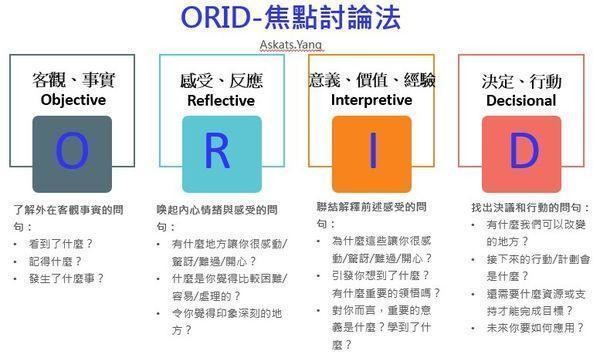
The Focused Conversation Method is a discussion approach developed by the Institute of Cultural Affairs in Canada. It uses effective questioning to promote deeper thinking, meaningful learning, and better team communication. ORID emphasizes the discussion process rather than the final decision. It helps present different viewpoints during the discussion and allows team members to stay on the same track and reach a consensus. During this Cyberfair project, since our team members come from different classes, ORID became a useful tool for our discussions. |
 |
ORID stands for the following four stages: |
 |
Objective (Facts) |
 |
Reflective (Feelings) |
 |
Interpretive (Meaning and Experience) |
 |
Decisional (Decision and Action) |
The Four Stages of ORID:
 |
1、Objective (Facts)「what do I see?」
At this stage, participants describe what they see, hear, or think about. Questions focus on facts and the current situation, helping participants discover objective information. Through each person’s observation, we understand that everyone may have different memories or perspectives on the same issue.
Examples: “What do you see in this picture?”
“What do you remember or learn from this lesson?”
|
 |
2、Reflective (Feelings) 「How do I feel?」
This stage focuses on participants’ reactions to the information. Participants are encouraged to share their personal thoughts and feelings about what they have just observed. All kinds of ideas are welcome, whether they are interesting or unusual.
Examples: “What part do you find interesting?”
“Is there anything that makes you feel frustrated?”
“What was the emotional highlight of this lesson?”
“How did you feel after the lesson ended?”
|
 |
3、Interpretive (Meaning and Experience) 「What do I learn/found/realize? 」
At this stage, guiding questions are used to help participants think more deeply about the discussion materials. Participants reflect on the meaning of the activity and share their personal understanding or opinions.
Examples: “What did you learn today?”
“What is the purpose of this activity?”
“What new understanding did you gain from this lesson?”
|
 |
4、Decisional(Decision and Action)「What shall we do next? 」
At this stage, participants summarize the various ideas and reach a conclusion. They decide what actions to take next based on the discussion results.
Examples: “How would you describe today’s work in one sentence?”
“What different actions will you take?”
“What changes should be made?”
|
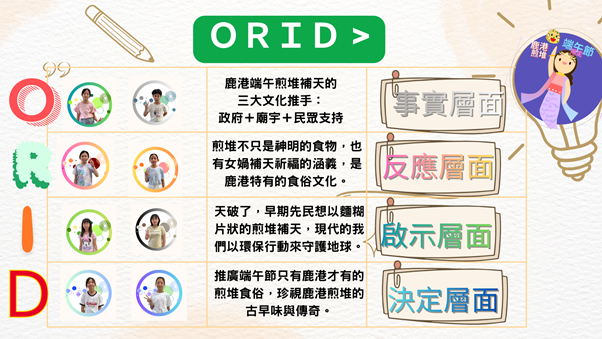
Discovering Lukang Jian Dui through ORID
 |
We found that each team member had different ways of thinking and analyzing the topic. Our teacher also praised our topic for having diverse perspectives and being comprehensive.
|
 |
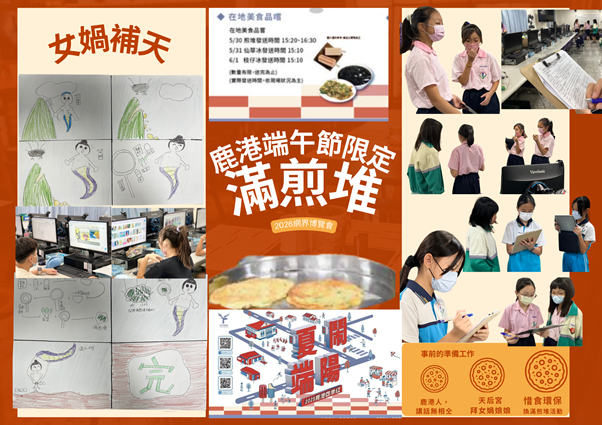
Since we come from different classes, using the ORID focused conversation method helped us integrate everyone’s opinions and make decisions about our research topic. As we were going to conduct street interviews during the Dragon Boat Festival a week later, we organized the information we had collected over the past two weeks and created a flyer with a four-panel comic about Nuwa Mending the Sky. This helped us explain our research more effectively during the interviews.
|
|