| |
• Gender:
□Male □Female
|
|
|
 |
|
 |
|
| |
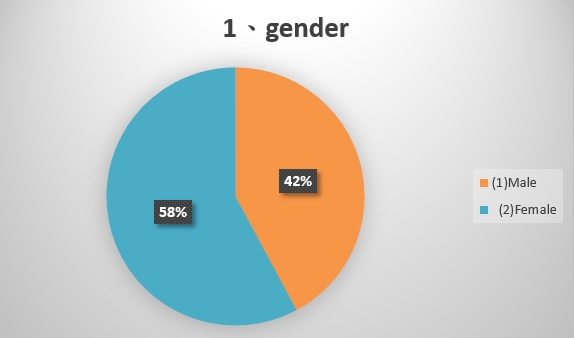
| It can be seen from the graph that the number of respondents who participated in the questionnaire was more girls than boys. |
|
|
|
|
• Identity:I am a student:
□ Lower grade of elementary school □Middle grade of elementary school □Upper grade of elementary school □Junior high school □High school □ College or above
• Identity:I'm not a student:
□ Ages 19-30 □Ages 31-45 □Ages 45-60 □Ages 61-75 □Ages 76 and above
|
|
|
 |
|
|
|
| |
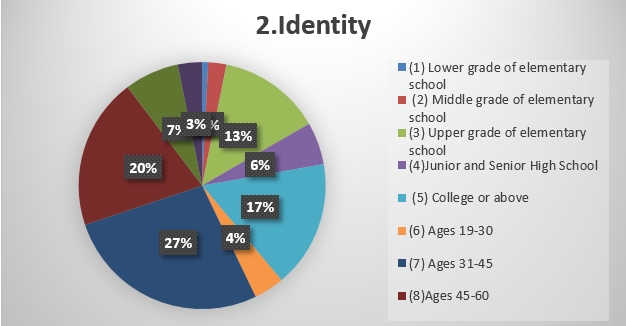
| The chart shows that among the survey respondents, the largest number were from college or above, followed by upper elementary school students. Among non-student respondents, the largest group was aged 31-45, followed by those aged 45-60. The 31-45 age group was the most represented among all survey respondents. |
|
|
|
|
• Place of residence:
□I am a Lukang resident □I am a tourist
|
|
|
 |
|
|
|
| |
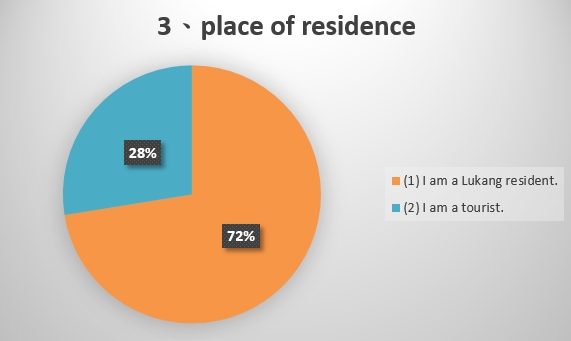
| The chart shows that the majority of respondents who participated in the survey lived in Lukang, accounting for 72%, while the majority were tourists, accounting for 28%. |
|
|
|
|
• Have you ever seen the characters "饘䬾"?(饘Mandarin pronunciation "jhan",䬾Mandarin pronunciation "ti")
□Yes □No
|
|
|
 |
|
|
|
| |
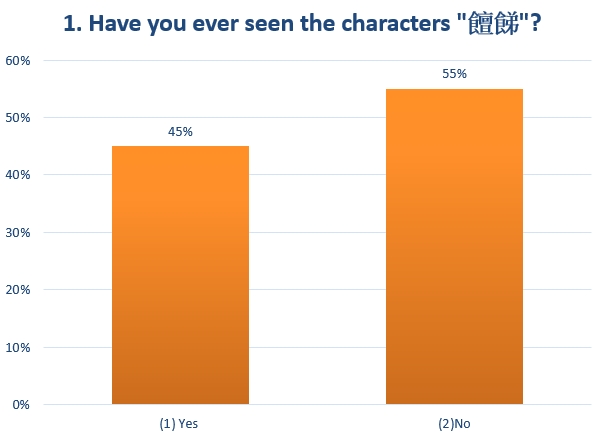
| The chart shows that 45% of people have seen the characters "饘䬾" before, while 55% have not. This indicates that most people are unfamiliar with the characters "饘䬾".
|
|
|
|
|
• How do you pronounce "Lukang Jian Dui"?
□tsian-tui
□tsian-te
□tsian-ter
□Can't pronounce Taiwanese
|
|
|
 |
|
|
|
| |
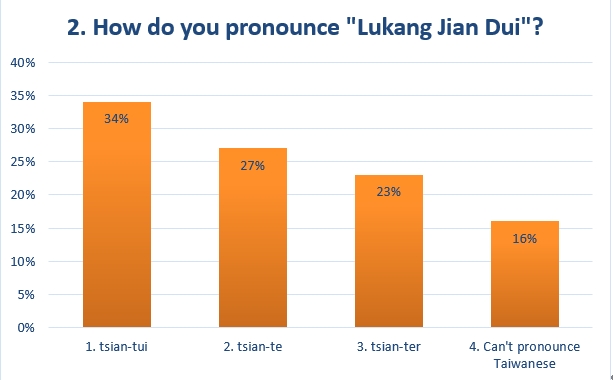
The chart shows that 34% of people think "Lukang Jian Dui" is pronounced "tsian-tui," 27% think it's "tsian-te," 23% think it's "tsian-ter," and 16% don't know how to pronounce it at all.
Actually, the Lukang dialect is a type of Quanzhou dialect, so the closest pronunciation is tsian-ter. Older generations of Lukang residents still retain the Lukang dialect when speaking, while younger Lukang residents use it less often due to changes in environment or language habits. However, 23% of respondents answered correctly, indicating that the Lukang dialect is still preserved and used by some people in Lukang.
|
|
|
|
|
• How did you know Lukang has "Jian Dui"?
□Heard from friends
□Heard from family
□Already knew
□Media reports
□Other
|
|
|
 |
|
|
|
| |
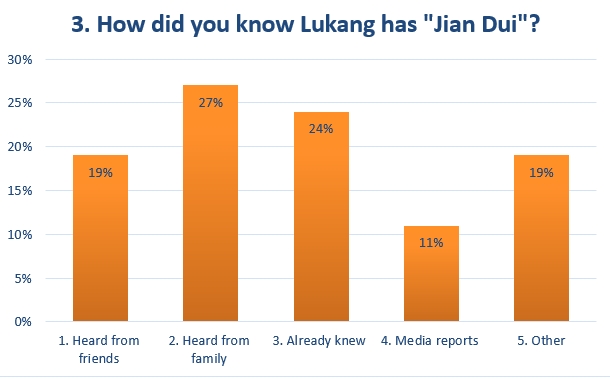
The chart shows that 27% of respondents learned about the "Jian Dui" custom in Lukang from family members; 24% already knew about it; 19% learned from friends or other sources; and 11% learned about it from media reports.
In Lukang, there's a custom of "Jian Dui" (a traditional offering to gods and ancestors) for worshipping deities during the Dragon Boat Festival every year. Because Lukang is the only place in Taiwan with this custom on this day, it evolved into the activity of frying "Jian Dui" at the Lukang City God Temple and distributing it to everyone. Therefore, this unique custom has been reported by the media in previous years. However, our survey found that as many as 70% of respondents (more than half) knew about it from family, friends, or were already aware of it. This shows that the "Jian Dui" custom of the Lukang Dragon Boat Festival is widely known.
|
|
|
|
|
• On Dragon Boat Festival, is frying "Jian Dui" only available in Lukang?
□I know □I don't know
|
|
|
 |
|
|
|
| |
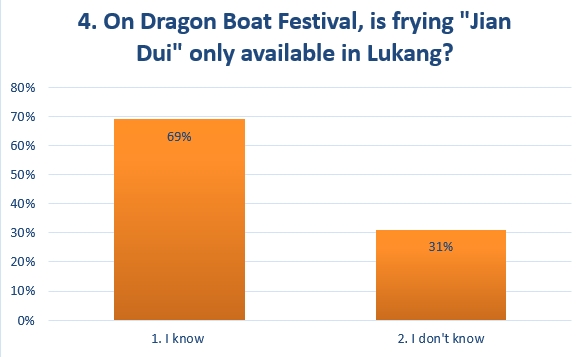
| The chart shows that 69% of respondents knew that "Jian Dui" is only performed in Lukang on Dragon Boat Festival, while 31% did not. This indicates that most respondents knew that the traditional custom of "Jian Dui" is only performed in Lukang on Dragon Boat Festival.
|
|
|
|
|
• Why did you queue up in Lukang to eat "Jian Dui"?
□Haven't tried it before, want to try it.
□Want to try it again.
□Joined the queue because there was a line
□Want to try queuing.
|
|
|
 |
|
|
|
| |
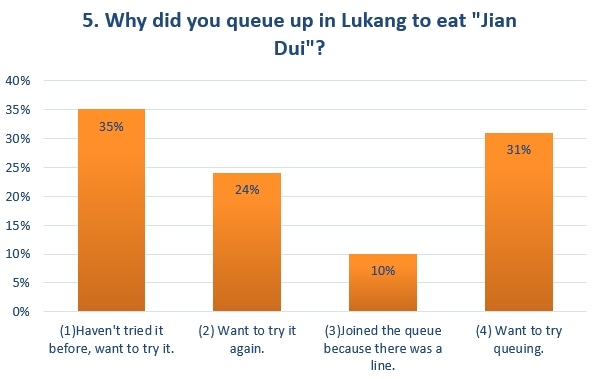
The chart shows that 35% of the people queued for "Jian Dui" in Lukang because they had never tried it before and wanted to try it; 31% were there because of a temple event offering "Jian Dui"; 24% wanted to try it again; and 10% were probably unsure of the situation and joined the queue just because there were people queuing.
We think that even if we've never had "Jian Dui" before, seeing everyone queuing up for free would make us want to join in and get some too. But the most interesting thing is that 10% of people actually saw people queuing and joined in without knowing what the event was about! That kind of adventurous spirit is truly amazing.
|
|
|
|
|
• The custom of eating "Jian Dui" is only found at the Lukang Dragon Boat Festival in Taiwan. Do you think it's related to the early settlers of Lukang coming from Quanzhou?
□It should be □I don't know
|
|
|
 |
|
|
|
| |
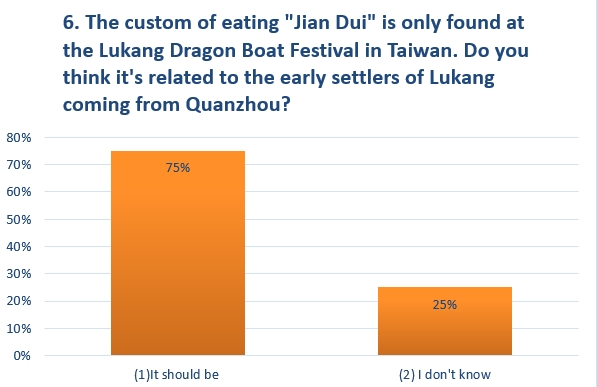
The chart shows that 75% of the respondents believed that only Lukang in Taiwan observes the "Jian Dui" custom during the Dragon Boat Festival, which is related to the fact that Lukang's early settlers came from Quanzhou; 25% were not know of this.
Because the majority of people in Lukang are immigrants from Quanzhou, not only does the Lukang dialect retain the Quanzhou accent, but traditional customs and temple worship culture also reflect this. Therefore, three-quarters of the respondents believed that Lukang's Dragon Boat Festival worship of "Jian Dui" is related to the fact that the early settlers of Lukang came from Quanzhou.
|
|
|
|
|
• Early May in the lunar calendar is the plum rain season in southern China. Legend has it that a crack appeared in the sky, causing the rain to pour down. Which legend do you think Lukang's "Jian Dui" (a local custom) is related to?
□Nuwa Mends the Sky □Shennong Tasting Herbs □Journey to the West □Legend of the White Snake
|
|
|
 |
|
|
|
| |
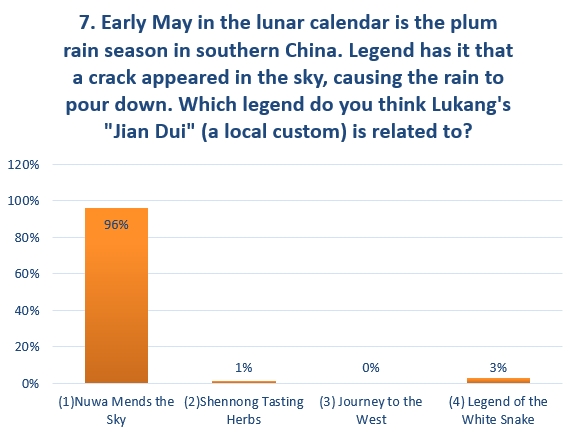
The chart shows that a staggering 96% of respondents believed the legend associated with Lukang's "Jian Dui" was "Nuwa Mends the Sky"; only 4% thought it might be related to the legends of "Shennong tasting hundreds of herbs" or "The Legend of the White Snake."
We deduce that because the question mentioned the plum rains in southern China in early May of the lunar calendar, which are said to be caused by a crack in the sky, resulting in continuous rain, this legend of "Nuwa Mends the Sky" is familiar to everyone, so most people answered correctly.
|
|
|
|
|
• What do you think is the significance of combining Lukang's "Jian Dui" with the legend of Mends the Sky?
□Our ancestors thanked the gods for their protection. □A deep reverence for nature. □ Prayers for favorable weather in the coming year.
|
|
|
 |
|
|
|
| |
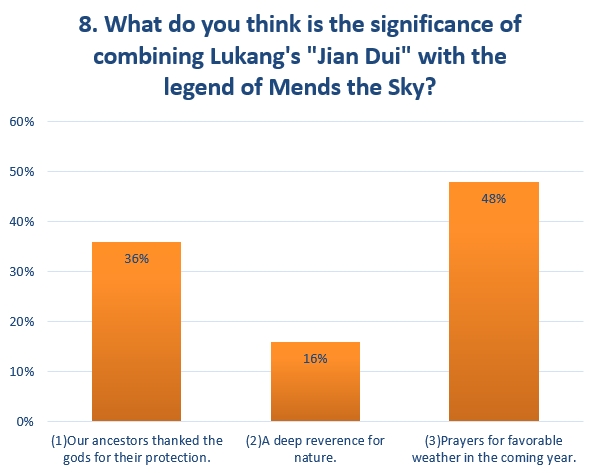
As the chart shows, regarding the legend of "Jian Dui" combined with "Mends the Sky" in Lukang, 49% of people believe it represents Prayers for favorable weather in the coming year; 37% believe it represents Our ancestors thanking the gods for their protection; and only 16% feel it represents a deep reverence for nature.
Our Ludong Elementary School Sky-Mending Team believes that the legend of "Jian Dui" in Lukang, combined with the story of Mends the Sky, represents our ancestors thanking the gods for their protection, praying for favorable weather in the coming year, and a deep reverence for nature. These three aspects are the meanings inherent in the legend of "Jian Dui" in Lukang, combined with the story of Mends the Sky.
|
|
|
|
|
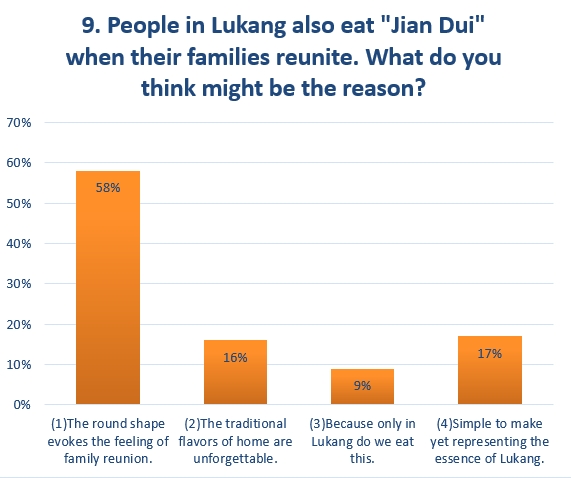
• People in Lukang also eat "Jian Dui" when their families reunite. What do you think might be the reason?
□The round shape evokes the feeling of family reunion.
□The traditional flavors of home are unforgettable.
□Because only in Lukang do we eat this.
□Simple to make yet representing the essence of Lukang.
|
|
|
 |
|
|
|
| |
The chart shows that Lukang residents also eat "Jian Dui" when family reunions. A significant 58% of respondents felt that the round shape evoked the feeling of family gatherings, hence the preference for "Jian Dui" during family reunions. 17% believed that "Jian Dui" is simple to make and has a representative flavor of Lukang, while 16% felt that "Jian Dui" is an unforgettable taste of their hometown, allowing them to reminisce about home. Only 9% felt that "Jian Dui" is a must-have for family reunions because only Lukang residents traditionally eat it at home.
Like most people, we find the taste of "Jian Dui" unforgettable. Because of its round shape, eating "Jian Dui" during family reunions feels like an indispensable ritual for the people of Lukang.
|
|
|
|
|
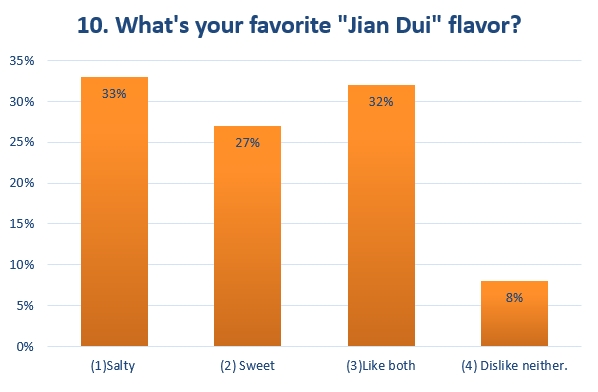
• What's your favorite "Jian Dui" flavor?
□Salty □Sweet □ Like both □Dislike neither.
|
|
|
 |
|
|
|
| |
The chart shows that 34% of people prefer the savory flavor of "Jian Dui"; 32% like both sweet and savory; 27% prefer the sweet flavor; and only 8% dislike it.
We believe "Jian Dui" is a very simple food to make. Because it's simple, it doesn't have many additives, allowing you to taste the natural flavor of the ingredients. Therefore, regardless of whether it's sweet or savory, a whopping 92% of people enjoy it. We are very happy that most people like "Jian Dui" after eating it.
The traditional flavors of "Jian Dui" were originally only sweet and savory. In 2025, the Lukang Township Office launched unprecedented seafood flavors such as razor clams and oysters for the Dragon Boat Festival, bringing new and exciting options to the traditional food and attracting people to learn about Lukang's Dragon Boat Festival customs.
|
|
|
|
|
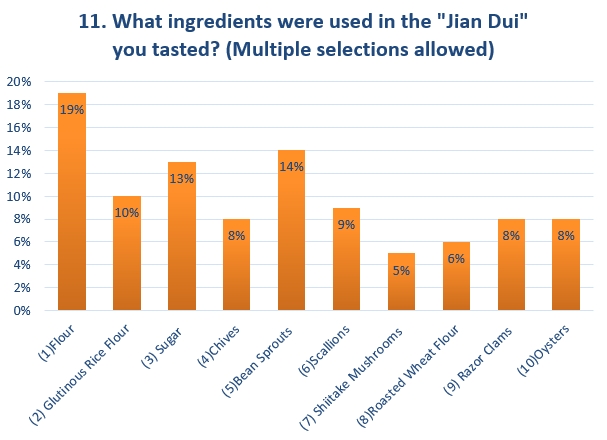
• What ingredients were used in the "Jian Dui" you tasted? (Multiple selections allowed)
□Flour
□Glutinous Rice Flour
□Sugar
□Chives
□Bean Sprouts
□Scallions
□Shiitake Mushrooms
□Roasted Wheat Flour
□Razor Clams
□Oysters
|
|
|
 |
|
|
|
| |
The chart shows that after eating "Jian Dui," 73 people guessed that the ingredients included flour, and 41 people thought it included glutinous rice flour. In reality, the batter only contains flour and no glutinous rice flour. Adding sugar makes it sweet "Jian Dui," so 51 people correctly guessed it contained sugar.
Regarding the savory "Jian Dui," 33 people thought it contained chives, 54 thought it contained bean sprouts, and 35 thought it contained scallions. In reality, the savory "Jian Dui" only contains salt, chives, and bean sprouts. We guess the bean sprouts were uncut and retained their sprout shape, hence the higher number of correct answers. The chives were cut into 1-2 cm pieces, leading many to confuse them with scallions, mistaking the green chives for scallions.
Scallions, shiitake mushrooms, roasted wheat flour, razor clams, and oysters are not traditional ingredients for Lukang's "Jian Dui." However, during the Dragon Boat Festival in 2025, the Lukang Township Office held a creative "Jian Dui" event at Lukang Assembly Hall, introducing seafood flavors such as razor clams and oysters. This gave the traditional dish a unique twist, attracting people to learn about Lukang's Dragon Boat Festival customs.
|
|
|
|
|
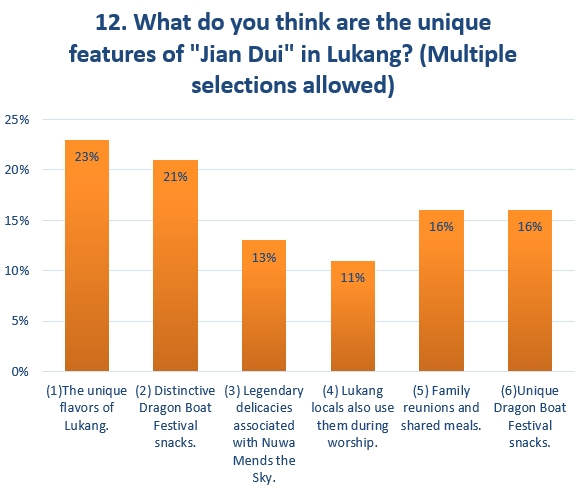
• What do you think are the unique features of "Jian Dui" in Lukang? (Multiple selections allowed)
□The unique flavors of Lukang
□Distinctive Dragon Boat Festival snacks
□Legendary delicacies associated with Nuwa Mends the Sky
□Lukang locals also use them during worship
□Family reunions and shared meals
□Unique Dragon Boat Festival
|
|
|
 |
|
|
|
| |
The chart shows that 23% of people believe the unique characteristic of Lukang "Jian Dui" is "The unique flavors of Lukang"; 23% believe Lukang "Jian Dui" is "Distinctive Dragon Boat Festival snacks"; 16% believe Lukang "Jian Dui" is "Family reunions and shared meals" and "Unique Dragon Boat Festival snacks" respectively; and 24% believe Lukang "Jian Dui" is related to during worship and legends.
Our Ludong Elementary School Sky-Mending Team members also believe that the most distinctive feature of Lukang's "Jian Dui" is its unique flavors, making it a "Distinctive Dragon Boat Festival snack." A teacher from the school shared with us that when he was a child, his family would sometimes make "Jian Dui" as a snack. Of course, if they didn't have many ingredients, they would simply add sugar to the batter and fry it—it was delicious! Sometimes, if they found cabbage, minced meat, or shrimp in the refrigerator, they would add them to the batter, mix well, and fry it—it was a delicious little snack! Everyone is welcome to try making their own unique "Jian Dui" at home.
|
|
|
|
|
|
| |
|