| Teacher HUANG, JING-YU / Taiwanese Language Teacher, Ludong Elementary School |
|
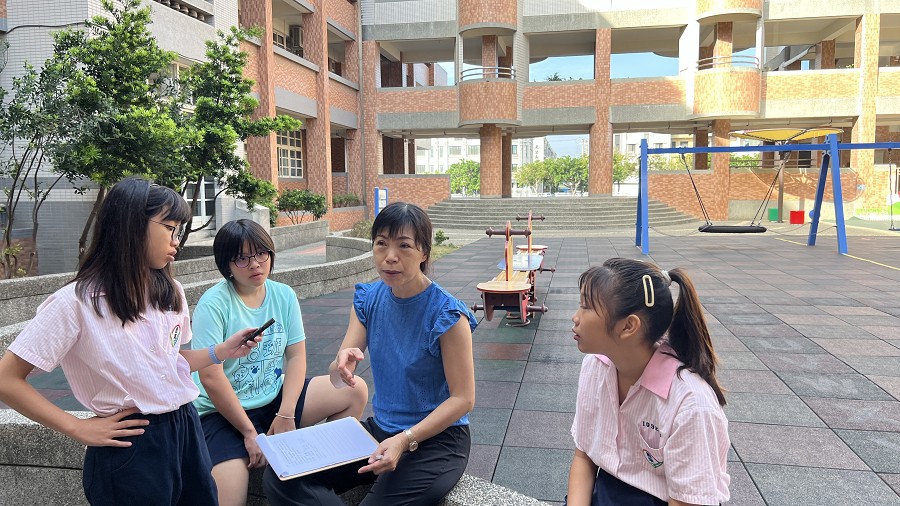
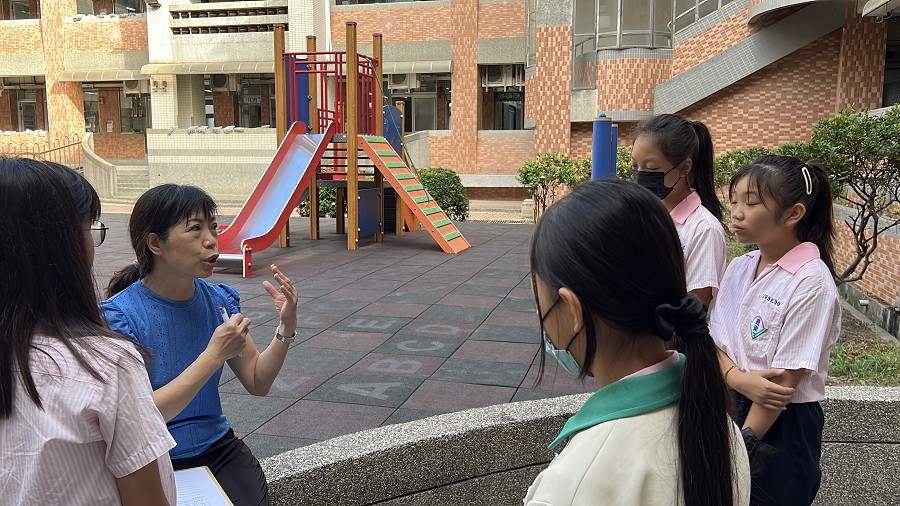
Interview Topic: Food Customs and Local Memories of the Lukang Dragon Boat Festival
Interview Location: Ludong Elementary School
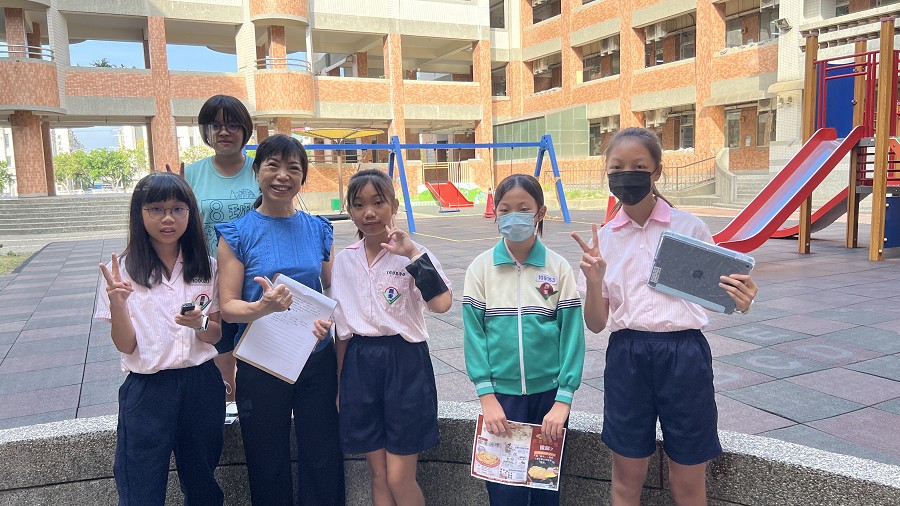
Interviewee: Teacher Huang, Jing-Yu
| |
 |
| |
| |
I. About "Jian Dui"
|
 |
Q1:What is "Jian Dui"? Is this custom only in Lukang?
|
 |
A1:The pronunciation of "Jian Dui" (tsian-tēr) in Taiwanese sounds similar to Ancient Chinese, and also like "tsiam-tēr" . Currently, the main places in Taiwan that preserve this custom are Lukang and Anping, with Lukang being particularly famous. For the people of Lukang, this is a very important tradition of the Dragon Boat Festival.From my childhood until now, every year during the Dragon Boat Festival, my family would fry "Jian Dui".
|
 |
Q2:What is the method and taste of "Jian Dui"?
|
|
A2:The traditional, simple way to make it at home is to mix flour, water, and a little sugar into a sticky batter. Then, heat some oil in a pan and fry the batter until it's flat and thin. It tastes best when freshly fried and hot. Because it's made of flour, it hardens when it cools down, resulting in a less desirable texture. Besides the sweet version, more discerning people add bean sprouts, chives, and salt, making it somewhat like a scallion pancake, but with a different texture. Because the "Jian Dui" isn't fermented, it won't be as chewy as a scallion pancake when cold.
|
 |
Q3:Why do we eat "Jian Dui" at the Lukang Dragon Boat Festival? Is there a legend or story behind it?
|
|
A3:This is related to the story of "Nuwa Mends the Sky." Legend has it that because there was a hole in the sky, it often rained before and after the Dragon Boat Festival. Sticky "paste sheets" were used to "mend the sky." Later, for convenience, flour was used instead, which is the origin of eating "Jian Dui" to mend the sky.
|
| |
II. Sacrificial Rites and Taboos
|
 |
Q4:During the Dragon Boat Festival worship, are bamboo-leaf-wrapped rice dumpling placed on the altar?
|
|
A4:Whether or not to offer bamboo-leaf-wrapped rice dumpling varies from family to family. In my family and some traditional families in Lukang, meat zongzi are not served as offerings. My mother's view is that meat zongzi are for people to eat, not for worship. Another custom is that if there is a death in the family, and the deceased has passed away within the past "one year" or "three years," one cannot make bamboo-leaf-wrapped rice dumpling or steamed rice cake (bamboo-leaf-wrapped rice dumpling or steamed rice cake symbolizes a joyous occasion). Rice dumplings or steamed rice cakes are usually delivered by relatives.
|
 |
Q5: Besides bamboo-leaf-wrapped rice dumpling, what other offerings are taboo during the sacrificial ceremony?
|
|
A5:Eldership is very particular about homophones, so there are a few things that cannot be worshipped.
* Shrimp (hê-á): Eating shrimp is believed to bring bad luck to the family「hê-hê-hê」, meaning being confused and muddled.
*Plate (phuân-á): My mother-in-law insists on not using plates for worship, but rather bowls or pots, because the pronunciation of "plate" sounds like "bô-puànn-phiat," meaning " that the descendants will be unsuccessful.
* Bamboo shoots (sún-á): The Taiwanese pronunciation is similar to "loss" (sún), which is considered unlucky and may harm future generations.
|
|
Q6:What are usually prepared during the Dragon Boat Festival worship?
|
|
A6:Our family always makes "Jian Dui" during worship. When I visited Lukang Longshan Temple, I saw that when they worshipped the gods, they prepared a plate of peaches, a plate of plums, and a plate of beautifully round fried "Jian Dui."
|
| |
III. Language and Life Memories
|
|
Q7:What are the characteristics of Lukang dialect?
|
|
A7:The Lukang dialect (Quanzhou dialect) retains many retroflex consonants, giving it a very old-fashioned feel.For example, "you (lí)" is pronounced "lú" in Lukang dialect.Older generations speak with a heavier intonation, and the entire sound is rolled up.
|
 |
Q8:What other vivid memories do you have of your early life?
|
|
A8:*Buying cooking oil: Cooking oil was very precious in the past. There was no bottled oil; you had to take your small teapot to the street to find a vendor to "tún-iû" (buy oil).
* Shampooing: Before shampoo, my grandmother used "tshâ-hu," the ash from burning firewood under the stove, to wash her hair. It was very effective at removing oil, leaving her hair black and shiny.
* Foot Binding: My grandmother had bound feet (commonly known as "three-inch golden lotuses"). Her feet were deformed and swollen like three-dimensional triangles. She often said it was extremely painful.
* Discipline: In the past, adults would say things like, "If you misbehave, I'll throw the cat into your wide-legged pants and it'll scratch "jiàu" your feet," using scary words to frighten children. Therefore, children were very obedient in the past.
|
 |
After listening to Teacher Huang's sharing, I realized how much knowledge is involved in Lukang's Dragon Boat Festival! What opened my eyes the most was the taboos during Worship. It turns out that shrimp sounds like "blind" in Chinese, and bamboo shoots are feared to "harm" descendants. These older generations' puns, though strict, hide deep blessings for their families. The teacher's descriptions of traditional life, such as washing hair with firewood ash and the pain of foot binding, were unimaginable to me. This interview not only taught me a few authentic Lukang dialect phrases, but also made me cherish these unique local memories even more. |
|